

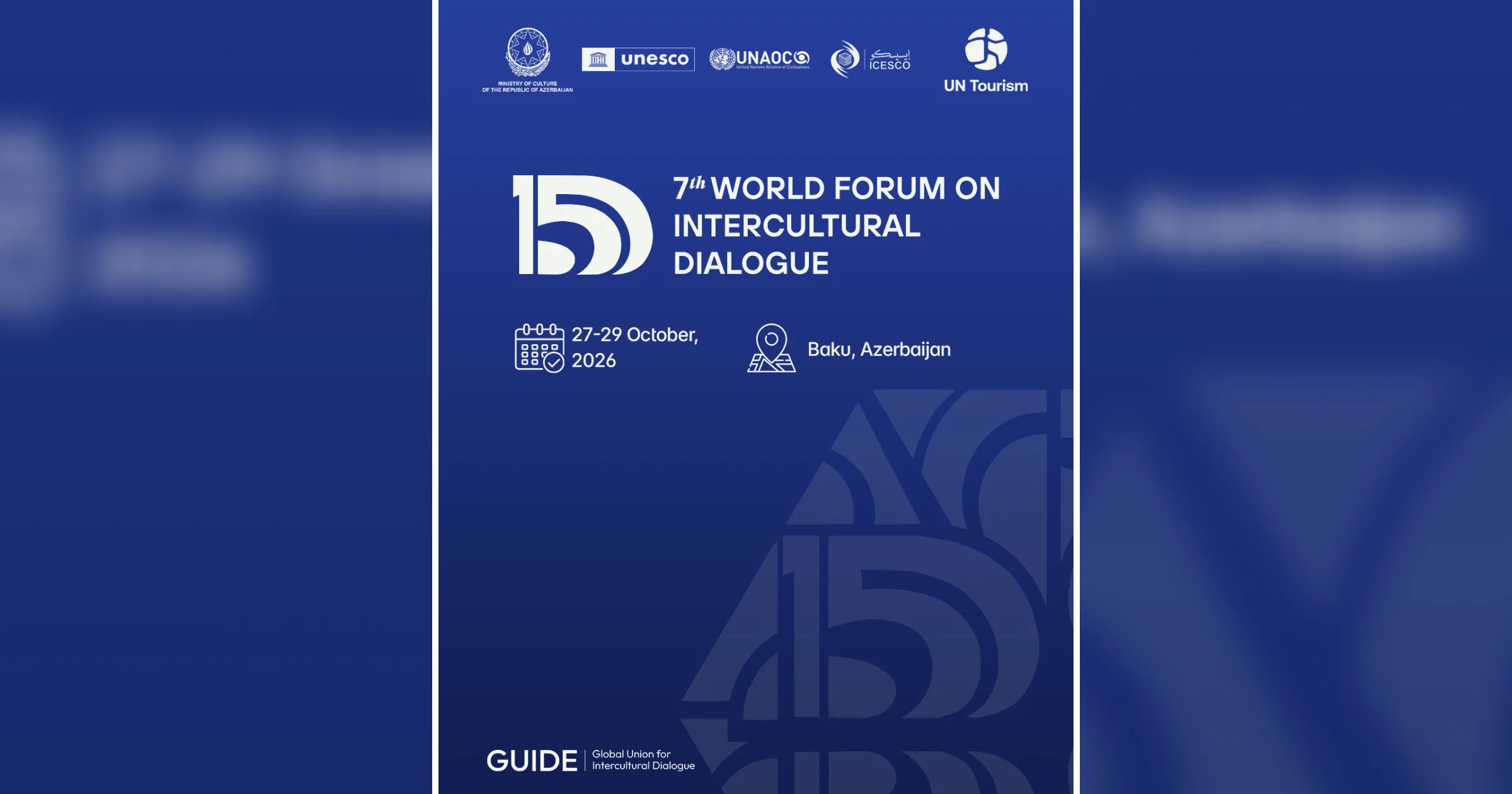
7th World Forum on Intercultural Dialogue

  • Status: Upcoming
  • Type: Forum
  • Format: In-person
  • Topics: Intercultural Dialogue | Cultural Diversity | Education | Youth | Research | Policy | Partnerships
  • Date: Start:
    October 27, 2026 - 09:00
    End:
    October 29, 2026 - 19:00
    Timezone:
    (UTC+04:00)
  • Location: Heydar Aliyev Center, Baku, Azerbaijan
Available in:

About

The 7th World Forum on Intercultural Dialogue convenes in Baku from October 27 to 29, 2026, marking the 15th anniversary of the Forum since it was first held in 2011 under the framework of the Baku Process. Bringing together heads of state and government, ministers, leaders of international organizations, parliamentarians, religious leaders, academics, civil society representatives, and youth from across the globe, the Forum is the preeminent international platform for advancing intercultural and intercivilizational dialogue.

The 2026 edition takes place at a moment of deep and widening global fragmentation. Political polarization, socioeconomic inequality, cultural misunderstanding, and the rapid advancement of technologies such as artificial intelligence are reshaping the conditions under which communities, nations, and civilizations relate to one another. Against this backdrop, the Forum's central theme frames dialogue not as a diplomatic courtesy but as a structural necessity — a foundational instrument for conflict prevention, human security, and the construction of a sustainable shared future.

The 7th WFID is organized within the framework of the Baku Process, co-organized by UNESCO, the United Nations Alliance of Civilizations (UNAOC), the Council of Europe, the Islamic World Educational, Scientific and Cultural Organization (ICESCO), UN Tourism, and the Food and Agriculture Organization of the United Nations (FAO), and hosted by the Ministry of Culture of the Republic of Azerbaijan. GUIDE serves as the operational secretariat of the Baku Process.
More Information

Six Core Objectives of the 7th World Forum on Intercultural Dialogue:

  • Reaffirming the Power of Dialogue: Emphasizing the indispensable role of intercultural dialogue as a practical instrument for conflict prevention, resolution, and the promotion of mutual respect among cultures and civilizations.

  • Identifying and Addressing Fractures: Exploring the root causes and manifestations of global fragmentation — including political polarization, economic inequality, social exclusion, and cultural misunderstanding — and developing concrete responses.

  • Promoting Bridge-Building Initiatives: Showcasing and developing practical strategies, policies, and grassroots initiatives that effectively bridge divides between communities, nations, and civilizations.

  • Forming a Common Vision for the Future: Encouraging participants to collectively commit to a future in which diversity is treated as a source of strength and global challenges are addressed through collaborative, cross-sectoral action.

  • Strengthening Sectoral Partnerships: Enhancing cooperation among governments, international organizations, civil society, academia, and the private sector in advancing intercultural understanding and peace.

  • Empowering Future Generations: Engaging youth and emerging leaders in meaningful dialogue and equipping them with the skills and perspectives necessary to navigate and shape a more inclusive and interconnected world.

Programme Format and Sessions

The 7th WFID brings together a wide range of participants through a multi-format programme designed to foster dialogue across sectors, disciplines, and communities. Sessions include:

  • Ministerial Meeting – A dedicated high-level gathering for ministers and country representatives to discuss policy and cooperation within the Baku Process framework.

  • High-Level Meeting of International Organizations – A platform for international bodies engaged in intercultural dialogue to coordinate efforts and strengthen partnerships.

  • Dialogue of Religions – A dedicated session for faith leaders and representatives of faith-based organizations to address interreligious harmony and spiritual dimensions of peacebuilding.

  • Youth Dialogue and Youth Forum – Dedicated platforms for young leaders to share perspectives, present initiatives, and engage directly in the Forum's agenda.

  • Women Dialogue – A session examining the role of women in advancing intercultural dialogue and peacebuilding.

  • Business Dialogue – Engaging entrepreneurs, tourism leaders, and private sector representatives in conversations on the role of business in intercultural cooperation.

  • Academic Dialogue – A scholarly platform for researchers and academics working in the field of intercultural and interreligious dialogue, including a special session at Karabakh University in Khankendi.

  • Breakout Panels – Thematic discussions on topics including artificial intelligence and digital societies, conflict transformation, tourism and intercultural connections, media and dialogue, museums and cultural heritage, and multiculturalism and peace.

  • #OneHumanity Concert – A gala cultural performance organized by UNAOC and the Ministry of Culture of Azerbaijan, bringing together musicians and artists from diverse backgrounds to perform on a shared stage.

  • Village of Cultures Festival – An open-air cultural festival on Baku Boulevard running throughout the Forum, featuring pavilions, performances, and exhibitions from participating countries and communities.

  • Exhibition: 15 Years of the Forum – A special photographic exhibition at Gulustan Palace marking the 15th anniversary of the World Forum on Intercultural Dialogue, tracing the history of the Forum and the global partnerships it has built since 2011.